Just thought this was interesting....
"The dancers' suits were outlined in multiple colors of EL, with an intentionally "loose" aesthetic that made them appear to be live dancing versions of a sketch."
EL wire: thin electroluminescent wire that looks like neon when hooked to a power source.
Thursday, May 20, 2010

Wednesday, May 19, 2010
Love your neighbors...
"If I define my neighbor as the one I must go out to look for, on the highways and byways, in the factories and slums, on the farms and in the mines - then my world changes. This is what is happening with the 'option for the poor,' for in the gospel it is the poor person who is the neighbor par excellence...
But the poor person does not exist as an inescapable fact of destiny. His or her existence is not politically neutral, and is not ethically innocent. The poor are a by-product of the system in which we live and for which we are responsible. They are marginalized by our social and cultural world. They are oppressed, exploited proletariat, robbed of the fruit of their labor and despoiled of their humanity. Hence the poverty of the poor is not a call to generous relief action, but a demand that we go and build a different social order."
Gustavo Gutierrez, The Power of the Poor in History
Gustavo Gutiérrez Merino, O.P., (born 8 June 1928 in Lima) is a Peruvian theologian and Dominican priest regarded as the founder of Liberation Theology. He sees that among the poor there is an “absence of recognition of their own human dignity and of their condition as daughters and sons of God”.
Friday, May 14, 2010
Another take on taxes.
Taxes are a way of buying into our government,
As a stakeholder buys shares into a corporation.
When you invest your resources,
You are more likely to invest your interest -
You care more because it involves your contribution,
And you care about your money
(Sometimes more than anything else).
A government that receives no money from its people,
Finds money elsewhere.
(From oil, for example.)
And it no longer needs to be as concerned about its people.
This is the story of a Middle East country,
As I hear it from my Middle Eastern friends.
Do we want our government to be like a business -
Whose primary concern is profit,
Or do we want a government who cares about its people -
Their rights, voices, and needs?
Pay taxes. Your government needs you and you need it.
Note: The author acknowledges that governments are inherently corrupt, however she maintains a naive belief that all human systems are redeemable. Furthermore, she has not found another system with less faults and is not willing to give up on the progress made so far - remembering those who work tirelessly for freedom in the past and in the present.
Monday, May 10, 2010
modern dance
 Occasionally I'll force myself to attend a modern dance performance. I'll find out about one either through a friend or an advertisement and I'll think "I should go because as a designer, this is an art form I should care more about." Or more honestly, "I should go because I want to be perceived as someone who cares about all art forms." And so I found myself, once again, sitting in a darkened theater, waiting for a performance to begin last Friday. The thick, traditionally red curtains drew back and twenty something dancers in pastel leotards began to rhythmically step onto the stage. I recognized one dancer, our friend, Chelsea - the one who had invited us to this particular performance - though the dancers are hard to identify due to their similarities in form, hair style, and makeup.
 I quickly realized that this was not the normally boring modern dance performance. First of all, the movements struck me as odd, particularly in their abruptness. Graceful, precise movements were mixed with quick sharp energy - a sudden nod of the head or shrug of the shoulders, for example. Some movements were filled with resistance, as though they were fighting the temptation to transform into an R&B step expected from those such as Lady Gaga.
Secondly, the dancers touched each other, which I also found odd. Their movements were carefully choreographed to overlap - clasping hands, bending and twisting over one another. In other performances, I've noticed a sense of isolation between the dancers - though they may be together on the stage, they individually complete similar moves as one might expect from a field of robots. These dancers were dependent on each other - each part had to work perfectly together to complete the whole - but beyond that, they changed each other's movements and paths. I know the entire performance is planned, yet it almost seemed as though they got to choose what to do and had to change their choices based on what the others did.
Thirdly, I was able to notice themes of meaning with each set. Normally in modern dance, I pretend that I understand a deeper meaning - as though some movements represent sadness while others joy. This time I didn't have to pretend or imagine - they communicated their message clearly with the music tempo, type, title, and selected movements. I felt as though I understood - which in my previous modern dance experience is rare.
A breath of fresh air full of meaning and depth, this modern dance performance was surprising and inspiring. Either this dance company is brilliant or I am finally "old" enough or "cultured" enough to get it. I'll conclude that San Francisco's Lines Ballet is truly brilliant.
Saturday, February 20, 2010
something politically positive...
Michelle Obama talks about her nationwide campaign to fight childhood obesity called "Let's Move."
Political party preferences aside, I think childhood obesity is a serious concern and am thankful for the media/conversations/awareness this campaign has launched. I look forward to hearing how they intend to achieve these goals - especially from a "top down" approach.
Berkeley has some pretty creative solutions that I am really proud of... such as Alice Waters' Elementary School Edible Garden Project and the Berkeley Ecology Center's plans to help local farmers markets accept food stamps.
What do you think?
(childhood obesity... not if you like Michelle or not :)
Thursday, January 28, 2010
Capp Street: Albany Waterfront
Twice in the last month I've managed to put Kevin into a panic concerning my safety. I love to walk and explore and sometimes I'll leave for a walk and wont return for several hours. This month, I've spent hours walking around one place - the Albany Waterfront. I want to "figure it out" - see who is there, what is there, and why. It is an unusual space; at times seeming purposely composed and at other times as though the whole park was created on accident. It is full of tension and opposing forces. I am drawn to the tension - frequently musing about how to resolve its strangeness.
This week, I took my camera along and tried to capture some of these relationships by photo. But first, I'd like to give you a better idea of where the waterfront is located. The first map shows the SF Bay area...


The next two photos symbolize growth versus decay. Both are happening at once. Bricks poke up out of the ground as you walk... Concrete chunks sit in the water... yet both are surrounded by green, growth and vitality.


I was very surprised (though in retrospect I should have not been) to see people secretly living on the waterfront. Some of the side trails led past several tents. People claim some of the land as their own and carve out their unique space. I didn't take many photos because I felt intrusive. Thankfully it was early in the morning and nobody really seemed to be awake.

Visitors, on the other hand, were primarily dog walkers/joggers. They didn't venture too far out onto the peninsula - perhaps they had previously wandered too far as I had.

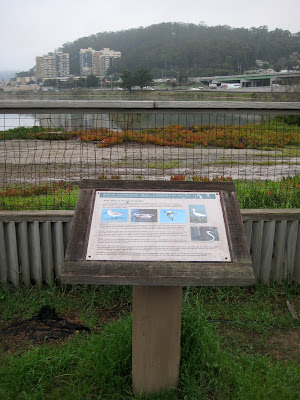
A large part of the waterfront is fenced off for restoration projects. One of the photos below shows signs put up along the beginning of the fence. A wood fence is only used near the entrance - it soon turns into the standard metal wire/chain link.

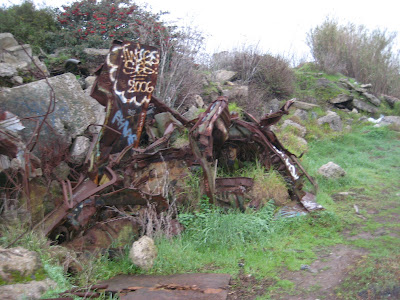
As I wandered further out I found larger piles of waste, including bundles of twisted metal, molding stretches of carpet, and discarded insulation. At the tip of the peninsula I found sculptures (made by visitors or residents?). This perfectly represented the tension between sculpture and junk. To one it is merely a medium for creative expression, to another it symbolizes the end of an idea.

I have seen random pamphlets around Albany inviting proposals to develop this land. I wonder what will come of it... will it become more "civilized" as it's neighbor, the Berkeley Marina, or will it maintain it's junk/raw character?
This week, I took my camera along and tried to capture some of these relationships by photo. But first, I'd like to give you a better idea of where the waterfront is located. The first map shows the SF Bay area...

This second map shows the waterfront park up close - the dots and numbers correspond to where I took the photos.

This first photograph captures the tension between Beauty/Water/Solitude and Traffic/Busy/Noise. There is a sandy beach, waves gently crashing into the rocks with industrial fragments/waste and a freeway lingering in the horizon. The noise is inescapable.

The next two photos symbolize growth versus decay. Both are happening at once. Bricks poke up out of the ground as you walk... Concrete chunks sit in the water... yet both are surrounded by green, growth and vitality.


I was very surprised (though in retrospect I should have not been) to see people secretly living on the waterfront. Some of the side trails led past several tents. People claim some of the land as their own and carve out their unique space. I didn't take many photos because I felt intrusive. Thankfully it was early in the morning and nobody really seemed to be awake.

Visitors, on the other hand, were primarily dog walkers/joggers. They didn't venture too far out onto the peninsula - perhaps they had previously wandered too far as I had.

A large part of the waterfront is fenced off for restoration projects. One of the photos below shows signs put up along the beginning of the fence. A wood fence is only used near the entrance - it soon turns into the standard metal wire/chain link.

This photo shows two paths - I noticed this as I was walking out, back to my own neighborhood. The path to the left, unpaved, belongs to the restoration while the path to the right, manicured and mowed, belongs to the neighboring racetrack. I find it ironic that there are two paths right next to each other. Did the racetrack decide to just ignore the existing path in an attempt to pretend it didn't exist?

As I wandered further out I found larger piles of waste, including bundles of twisted metal, molding stretches of carpet, and discarded insulation. At the tip of the peninsula I found sculptures (made by visitors or residents?). This perfectly represented the tension between sculpture and junk. To one it is merely a medium for creative expression, to another it symbolizes the end of an idea.


I have seen random pamphlets around Albany inviting proposals to develop this land. I wonder what will come of it... will it become more "civilized" as it's neighbor, the Berkeley Marina, or will it maintain it's junk/raw character?
Wednesday, January 27, 2010
Designers to create change
Cameron Sinclair, of the Open Architecture Network, says, "We believe that where resources and expertise are scarce, innovative, sustainable and collaborative design can make a difference." And he isn't the only one who believes this - as there is a growing grassroots movement of designers who are embracing the opportunity to create change in the world. Paul Hawkin, in his book, Blessed Unrest, expounds on this movement. It is a movement without centralized leadership, a movement of nonprofits, a movement of compassion and action. (See video below - approximately 5 minutes long.)
It is very inspiring and motivating to learn about this movement of people. Cameron Sinclair said they started this type of work because nobody told them they couldn't. They wanted to use design and architecture to create change, rather than to create "jewels" they could admire for themselves.
To me, as a design student, this seems rather logical and obvious. Perhaps it is due to the acceptance and application of "design thinking" or perhaps it is simply a matter of timing - I was brought into school after this movement had began so I don't fully understand the implications of the contrast with before.
"Design thinking" is a term that CCA often uses that I believe represents the type of thinking mentioned above. Design thinking addresses complexity, systems, context, consequences... rather than designing isolated and individual items to make a profit. Perhaps there is a subtle but large change in motivation taking place that leads to a different destination or end goal - one that strives to maximize the amount of positive change rather than acquire the largest profit (regardless of positive or negative change created in society/culture.) If so, it is an exciting time to be a part of the design world, as roles adapt and expand with ideas.
On a more personal note, my husband is the president of a non-profit organization, called Mosaic, in Berkeley with a similar mission. The organization's motto "Mosaic is a movement of dreamers, poets and activists passionate about the future. Our aim is to bring dignity to humanity’s spiritual journey and to empower people to create a better world." (From the website: www.mosaicbay.org) Mosaic strives to connect people and ideas to action through leadership development, self-awareness, volunteer opportunities, creativity workshops, and spiritual revival.
Last summer, my husband, Kevin, organized a team of architects, engineers, and humanitarians to go to Southern Sudan to build a school. The project has actually been posted on the Open Architecture Network under the name Jalle Primary School and on the partner organization website: rebuildsudan.org. Mosaic partnered with Rebuild Sudan and EMI (a volunteer engineering organization) to design the school last May. After their return, we've focused on hosting fundraisers and sharing the stories of the Sudanese people. We hope to plan another trip during the summer of 2010 to begin construction and address other issues such as water access, infrastructure, etc. I did not go on the first trip, as the timing interfered with another project I was working on with an architecture firm, however, I look forward to learning more about how design can create change, whether it is local or global, and how business strategy can support and encourage these goals.
Thursday, January 21, 2010
Moo - politics and cows
(I saw this while doing some research on politics for one of my classes this semester - what do you think? I like it.)
POLITICAL SCIENCE & ECONOMICS FOR DUMMIES
DEMOCRAT
You have two cows. Your neighbor has none. You feel guilty for being successful.
REPUBLICAN
You have two cows. Your neighbor has none. So?
SOCIALIST
You have two cows. The government takes one and gives it to your neighbor. You form a cooperative and tell him how to manage his cow.
COMMUNIST
You have two cows. The government seizes both and provides you with milk. You wait in line for hours to get it. It is expensive and sour. CAPITALISM, AMERICAN STYLE
You have two cows. You sell one, buy a bull, and build a herd of cows.
BUREAUCRACY, AMERICAN STYLE
You have two cows. Under the new farm program, the government pays you to shoot one, milk the other, and then it pours the milk down the drain.
AMERICAN CORPORATION
You have two cows. You sell one, lease it back to yourself, and do an IPO on the 2nd one. You force the two cows to produce the milk of four cows. You are surprised when one cow drops dead. You spin an announcement to analysts stating that you have downsized and are reducing expenses. Your stock goes up. Life is good.
FRENCH CORPORATION
You have two cows. You go on strike because you want three cows. You go to lunch and drink wine. Life is good.
JAPANESE CORPORATION
You have two cows. You redesign them so they are one-tenth the size of an ordinary cow and produce twenty times the milk. They learn to travel on unbelievably crowded trains. Most are at the top of their class at cow school.
ITALIAN CORPORATION
You have two cows. Yet you don’t know where they are. While ambling around, you see a beautiful woman. You break for lunch. Life is good.
TALIBAN CORPORATION
You have all the cows in Afghanistan, which are two. You don’t milk them, because you cannot touch any creature’s private parts. You get a $40 million grant from the US government to find alternatives to milk production but use the money to buy weapons.
POLISH CORPORATION
You have two bulls. Employees are regularly maimed and killed attempting to milk them.
FLORIDA CORPORATION
You have a black cow and a brown cow. Everyone votes for the best looking one. Some of the people who actually like the brown one best accidentally vote for the black one. Some people vote for both. Some people vote for neither. Some people can’t figure out how to vote at all. Finally, a bunch of guys from out-of-state tell you which one you think is the best-looking cow.
CALIFORNIA CORPORATION
You have millions of cows. They make real California cheese. Only five speak English. Most are illegal. Arnold likes the ones with the big udders.
Monday, November 30, 2009
Design is not just decorative...
One of my designs is in the process of being built! Completion date has been moved to February. I am SO EXCITED. See some photos below.



Thanksgiving evening we gathered around our living room to watch a film – While You Were Sleeping. Despite its charming and romantic plot, it was easy to discern the movie’s age due to the fashion and humor changes during the last 15 years. In contrast, its hospital interiors accurately reflected what I would expect to see today. In other words, changes in fashion, language and humor were easily identifiable though the architecture and interiors did not seem to change at all. As a design student, I was taught to believe that the built environment acted as a cultural catalyst for change and critical thought. Unfortunately, it no longer seems to hold this position, instead it trails dreadfully behind art, technology, and design – especially in healthcare design.
Creativity is hidden behind a sturdy wall of excuses in healthcare design. This wall is several feet thick – built by the value engineers, the financers, the doctors and nurses, hospital CEOs and administrative staff, lawyers, technicians and even architects. Finding a way to introduce innovation in healthcare design is like looking for a tiny crack in a dam. It is not surprising that most designers settle for the “usual” due to frustration and impatience.
I searched and researched for several weeks – looking for a tiny crack in the wall. I composed presentation boards showcasing “cutting edge” European designs and the most updated scientific research supporting color and technology alternatives… but every time they would find an excuse, a reason, something, anything, to avoid pursuing solutions outside of the familiar white washed walls, long, straight corridors, and VCT rigid squares.
After months of research and meetings, an administrative officer asked about using energy efficient lighting and updating the current standardized fixtures. Without my input, the board of directors, planners, lawyers, etc. quickly agreed to update the standard – revealing the perfect crack. Through innovative lighting fixtures, I could design in creative and unexpected ways. I suggested using color changing LED light fixtures as decorative and functional pieces in hallways, waiting rooms, and lobbies. Other fixtures could be used to cast unusual and artistic shadows on walls – spaces typically covered with framed paintings. These fixtures were able to escape the regular list of excuses and hesitations because they were necessary – essential for both function and design.


Thanksgiving evening we gathered around our living room to watch a film – While You Were Sleeping. Despite its charming and romantic plot, it was easy to discern the movie’s age due to the fashion and humor changes during the last 15 years. In contrast, its hospital interiors accurately reflected what I would expect to see today. In other words, changes in fashion, language and humor were easily identifiable though the architecture and interiors did not seem to change at all. As a design student, I was taught to believe that the built environment acted as a cultural catalyst for change and critical thought. Unfortunately, it no longer seems to hold this position, instead it trails dreadfully behind art, technology, and design – especially in healthcare design.
Creativity is hidden behind a sturdy wall of excuses in healthcare design. This wall is several feet thick – built by the value engineers, the financers, the doctors and nurses, hospital CEOs and administrative staff, lawyers, technicians and even architects. Finding a way to introduce innovation in healthcare design is like looking for a tiny crack in a dam. It is not surprising that most designers settle for the “usual” due to frustration and impatience.
I searched and researched for several weeks – looking for a tiny crack in the wall. I composed presentation boards showcasing “cutting edge” European designs and the most updated scientific research supporting color and technology alternatives… but every time they would find an excuse, a reason, something, anything, to avoid pursuing solutions outside of the familiar white washed walls, long, straight corridors, and VCT rigid squares.
After months of research and meetings, an administrative officer asked about using energy efficient lighting and updating the current standardized fixtures. Without my input, the board of directors, planners, lawyers, etc. quickly agreed to update the standard – revealing the perfect crack. Through innovative lighting fixtures, I could design in creative and unexpected ways. I suggested using color changing LED light fixtures as decorative and functional pieces in hallways, waiting rooms, and lobbies. Other fixtures could be used to cast unusual and artistic shadows on walls – spaces typically covered with framed paintings. These fixtures were able to escape the regular list of excuses and hesitations because they were necessary – essential for both function and design.
Thursday, November 12, 2009
The Safe Hug
For a graduate writing class, a classmate and I created a "how to" for hugs. We both did a lot of research on hugs - including how people greet each other in different cultures and how NOT to hug. The goal of the assignment was to study process writing - instruction manuals, etc. These are often ignored or overlooked by designers (hence the reason most people don't even bother to read them). The project required the creation of a instruction guide - either using digital or print media. We could study an actual object or a human interaction/experience. We choose the "hug" due to its influence and relevance in our lives. For example, those who are touched or hugged daily are proven to have lower blood pressure...
Hope you enjoy the video - it was a fun project for us.
Hope you enjoy the video - it was a fun project for us.
Sunday, October 04, 2009
Is it worth it?

Last week, in my Nonfiction Writing class, we watched the film Manufactured Landscapes. Since then, it's been on my mind constantly. Over the last few years, the issues raised in the film have transformed my perspective on economics, world trade, personal as well as national finances, technology and capitalism, etc. It is hard to find an aspect of life unaffected by this issue.
You can watch a short video of some photographs from the film on the photographer's website - Edward Burtynsky. Select "Worldchanging" from the links on the left - then "View the Worldchanging.com Introduction Video".
A summary from his website:
Shot in Super-16mm film, Manufactured Landscapes extends the narrative streams of Burtynsky’s photographs, allowing us to meditate on our profound impact on the planet and witness both the epicentres of industrial endeavour and the dumping grounds of its waste. What makes the photographs so powerful is his refusal in them to be didactic. We are all implicated here, they tell us: there are no easy answers. The film continues this approach of presenting complexity, without trying to reach simplistic judgements or reductive resolutions. In the process, it tries to shift our consciousness about the world and the way we live in it.
After watching something like this - it is hard for me to understand why anyone would still support oil production and consumption. How can we continue in this way while so many others suffer the consequences? It may save us a few dollars, but it costs others their lives. Is oil really worth it? Especially when alternatives such as wind and solar exist?
Wednesday, September 09, 2009
Look what I made...
I am taking a 3D Rhino rendering class (a software class that teaches you how to build small objects on the computer). And here is the first item I choose to try - a spool of ribbon. Yay!


Saturday, September 05, 2009
What I said...
To my studio professor and classmates last week....
After saying my name and undergraduate background I spoke about my experience with architecture. Since I can't remember my exact words I'll summarize:
In the four years I worked as an interior architect, I found that 80% was about details such as roofing, water protection, structural connections, stud wall construction, and hours upon hours of drawing tiny details. I hated it because it was so boring. The 20% I loved was about design - how people interact with space, concept development, programming - understanding human needs... In four years I decided that the 80% I hated wasn't worth enduring for the 20% I loved. I longed for a job where the ratios were flipped and wasn't ready to give up searching for it. I had taken product design classes in undergrad and really enjoyed them. I decided to invest in developing that interest to see where it leads. I am in grad school, not necessarily to be torn down and rebuilt, but to find my life's questions in the pursuit of industrial design. I am going to CCA to help uncover these questions - these questions that I will spend the rest of my life working out. (At this point I referenced the reading he had asked us to do this summer - Seeing is Forgetting the Name of the Thing One Sees - a book about the artist Robert Irwin. I LOVED the book so I couldn't help but bring it up. I looked like a total suck up... be seriously I just loved the book.)
My professor asked me, "How will you know when you've found them?"
I replied, "You just know. It's the thing you keep coming back to. You know when you've found something worth living for. Something worth waking up for. Something that energizes you - that compels you - that makes your heart beat. You just know."
Upon further reflection, I wish I would have added that, as Robert Irwin said, it is about a combination of logic and intuition. Logic evaluates measurable data, the science. Intuition is linked to a sense of spirit, of being, of understanding beyond words. You can limit yourself to just logic - but still be wrong because life doesn't always work in logical ways. The unexpected happens, people change their minds, emotions shift. That is where intuition is key... the key to discerning the stuff not measured by logic or science. The combination of the two is where confidence and faith are found.
That is how "you just know." And now you all know why I think I am in grad school :)
After saying my name and undergraduate background I spoke about my experience with architecture. Since I can't remember my exact words I'll summarize:
In the four years I worked as an interior architect, I found that 80% was about details such as roofing, water protection, structural connections, stud wall construction, and hours upon hours of drawing tiny details. I hated it because it was so boring. The 20% I loved was about design - how people interact with space, concept development, programming - understanding human needs... In four years I decided that the 80% I hated wasn't worth enduring for the 20% I loved. I longed for a job where the ratios were flipped and wasn't ready to give up searching for it. I had taken product design classes in undergrad and really enjoyed them. I decided to invest in developing that interest to see where it leads. I am in grad school, not necessarily to be torn down and rebuilt, but to find my life's questions in the pursuit of industrial design. I am going to CCA to help uncover these questions - these questions that I will spend the rest of my life working out. (At this point I referenced the reading he had asked us to do this summer - Seeing is Forgetting the Name of the Thing One Sees - a book about the artist Robert Irwin. I LOVED the book so I couldn't help but bring it up. I looked like a total suck up... be seriously I just loved the book.)
My professor asked me, "How will you know when you've found them?"
I replied, "You just know. It's the thing you keep coming back to. You know when you've found something worth living for. Something worth waking up for. Something that energizes you - that compels you - that makes your heart beat. You just know."
Upon further reflection, I wish I would have added that, as Robert Irwin said, it is about a combination of logic and intuition. Logic evaluates measurable data, the science. Intuition is linked to a sense of spirit, of being, of understanding beyond words. You can limit yourself to just logic - but still be wrong because life doesn't always work in logical ways. The unexpected happens, people change their minds, emotions shift. That is where intuition is key... the key to discerning the stuff not measured by logic or science. The combination of the two is where confidence and faith are found.
That is how "you just know." And now you all know why I think I am in grad school :)
You are quite eloquent.
Last week, upon introducing myself to my studio professor and explaining why I am here in grad school... he simply raised his eyebrows, looked down at his notebook, and said "You are quite eloquent."
Today, I looked up the word in the dictionary - though I know exactly what it means I was looking for some hidden meaning...
Here is a little blurb from dictionary.com:
Eloquent, fluent, articulate, expressive are adjectives that characterize speech or speakers notable for their effectiveness. Eloquent suggests clarity and power.
Clarity and power.
Love it.
Unfortunately, it took four years of thought to express those four sentences to my professor. If only I could be eloquent with less time!
Today, I looked up the word in the dictionary - though I know exactly what it means I was looking for some hidden meaning...
Here is a little blurb from dictionary.com:
Eloquent, fluent, articulate, expressive are adjectives that characterize speech or speakers notable for their effectiveness. Eloquent suggests clarity and power.
Clarity and power.
Love it.
Unfortunately, it took four years of thought to express those four sentences to my professor. If only I could be eloquent with less time!
Friday, September 04, 2009
Even more construction...
Photos from the latest construction site visit... occupancy is still set for January but it looks like it is coming together quite quickly. I regret not being able to be there during completion - but know grad school is an opportunity I couldn't afford to wait on. Thankfully, my ex co-workers are pretty great about keeping me in the loop!
The waiting room... the ceiling grid is up and the panels about to be installed!

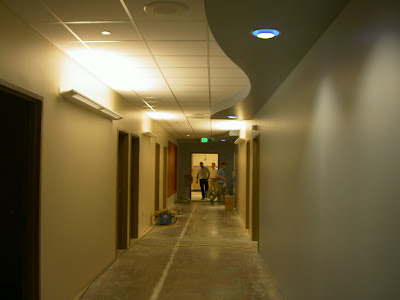
A view down on of the corridors. I put color changing LED lights in the soffits - right now the hospital is trying to decide how to use them. I really focused on the lighting fixtures in the design due to the fact that this space has no access to daylight at all (it's in the basement of the hospital like all xray departments typically are).

And the "special feature" aka. light display at the end of the corridor is ready to be set up!

The waiting room... the ceiling grid is up and the panels about to be installed!

A view down on of the corridors. I put color changing LED lights in the soffits - right now the hospital is trying to decide how to use them. I really focused on the lighting fixtures in the design due to the fact that this space has no access to daylight at all (it's in the basement of the hospital like all xray departments typically are).

And the "special feature" aka. light display at the end of the corridor is ready to be set up!

Saturday, August 29, 2009
It all began with Barbie...
A video I composed sharing a short story about myself as part of grad school orientation. We had two and a half days to compose the video and then spent an evening viewing each other's stories. Class starts this week (tomorrow!)... this was just a simple "get to know you" exercise :)
Wednesday, August 26, 2009
Into the "Older Than"
Just finished grad school orientation... two days full of long meetings and lines. So far so good. I've been trying to meet as many people as I can remember. I have to be careful b/c at some point I start to lose track of names or they all start to blend together. Despite my introverted self, I've managed to meet quite a few people and learn some interesting characteristics about my design class.
There are 48 of us.
We are...
...Primarily female.
...Mostly under the age of 25
...Not likely to have held a "professional" job
...Over half have experience/education in graphic design
...All but three of us have iphones (I am one of the three)
...Diverse in that our class has the most international students than ever before
...Single (I have yet to meet another married student in my year)
I was sitting around at a table with five other classmates and they were announcing their age and relationship status. The combination of my age, experience and marriage make me feel so much older than at least half of my class. For the first time in my life, I realized I was now in the category of life called "Older Than"... where the world is slowly starting to get younger and younger as I get older.
I have no doubt that these students are incredibly talented, creative, and intelligent regardless of age and relationship status. I am in no way "above" them... the only thing I am is increasingly unable to let myself use the excuse of "oh I'm just young". But in grad school, and possibly in life, we all have one thing in common - we are here to learn and grow - and that alone makes age irrelevant.
There are 48 of us.
We are...
...Primarily female.
...Mostly under the age of 25
...Not likely to have held a "professional" job
...Over half have experience/education in graphic design
...All but three of us have iphones (I am one of the three)
...Diverse in that our class has the most international students than ever before
...Single (I have yet to meet another married student in my year)
I was sitting around at a table with five other classmates and they were announcing their age and relationship status. The combination of my age, experience and marriage make me feel so much older than at least half of my class. For the first time in my life, I realized I was now in the category of life called "Older Than"... where the world is slowly starting to get younger and younger as I get older.
I have no doubt that these students are incredibly talented, creative, and intelligent regardless of age and relationship status. I am in no way "above" them... the only thing I am is increasingly unable to let myself use the excuse of "oh I'm just young". But in grad school, and possibly in life, we all have one thing in common - we are here to learn and grow - and that alone makes age irrelevant.
Thursday, August 13, 2009
Vertigo

Tonight a few friends and I went to watch the Alfred Hitchcock film Vertigo at the Cal Berkeley Pacific Film Archive. I did not know anything about the film aside from a short trailer I found on YouTube. The film's plot completely surprised me - I am not an "old" movie fan so my response could be purely naive - but I was very impressed with the cleverness of the writing, directing, and acting. Nearly two hours after watching the film, I am still recovering from shock over the ending.
Aside from the things already mentioned - I also noticed how much HASN'T changed since the 1950s - like pumps (high heeled shoes) and business suits, wallpaper designs (large patterns are all the rage right now), blankets with satin or silk edging, stainless steel teapots, etc. The most noticable change (filming technology aside) was the automobiles. In general, it seems that behaviorally people seem pretty consistent - but technology seems to cause the greatest amount of change in the least amount of time. Technology and jeans. Everyone in the film wore a suit, slacks or dress/skirt because jeans hadn't become mainstream yet. Oh how jeans have transformed our day to day clothes!
Monday, June 29, 2009
Dune - revisited
Now I’m serious…
About this whole sci-fi thing.
I’ll prove it.
I read Dune – “considered by some to be the greatest science fiction novel of all time.”
Was it?
Sure… I don’t think reading one (or a handful) of sci-fi books really makes me qualified to judge though. I like this science fiction genre – speculations on the future based on actuality (to put it simply). It helps to compare it to fantasy which is not based on reality or any relation to it. So here we have an entire genre devoted to exploring an imaginary yet probable vision of the future. Who could resist the curiosity it induces?
Mere curiosity?
Of course not – my real motivation is always design based. I want to know what could be – and study fantastic and elaborate interpretations of the future in hopes of expanding my limited perspective of the now.
Take Dune for example – I LOVED the stillsuits – a technological innovation of the sand dwellers that enabled them to reclaim their body moisture. From the moment they were first introduced I can’t get them out of my head – I’ve spent several random distracted moments thinking about them and how it would actually work. Could we use these now? What about developing countries with limited or no access to water?
Always wondering…
About this whole sci-fi thing.
I’ll prove it.
I read Dune – “considered by some to be the greatest science fiction novel of all time.”
Was it?
Sure… I don’t think reading one (or a handful) of sci-fi books really makes me qualified to judge though. I like this science fiction genre – speculations on the future based on actuality (to put it simply). It helps to compare it to fantasy which is not based on reality or any relation to it. So here we have an entire genre devoted to exploring an imaginary yet probable vision of the future. Who could resist the curiosity it induces?
Mere curiosity?
Of course not – my real motivation is always design based. I want to know what could be – and study fantastic and elaborate interpretations of the future in hopes of expanding my limited perspective of the now.
Take Dune for example – I LOVED the stillsuits – a technological innovation of the sand dwellers that enabled them to reclaim their body moisture. From the moment they were first introduced I can’t get them out of my head – I’ve spent several random distracted moments thinking about them and how it would actually work. Could we use these now? What about developing countries with limited or no access to water?
Always wondering…
Thursday, June 25, 2009
The Bible as Human Literature
KV and I have been discussing this on and off for the last few years - especially since he went to seminary and learned more about the authors of this ancient text. One of leaders he respects recently wrote a blog post about this subject. It was so thought provoking I had to pass it along. What do you think?
"The Bible is only human literature.
Breathe.
I have a question I want to consider, and I have asked this question at the end of this post. But let’s begin with this lesser question:
Why does embracing the Bible as human literature disorient some of us?
Perhaps it is because many of us are so used to being told that the Bible is a book written by God — The Bible is God’s word. But the Bible is not written by God. It is written by humans.
Having said that, does claiming that the Bible is only human literature mean the Bible is false? Of course not.
The New York Times is also produced by humans. Does that mean it is false? Of course not.
The Bible is only human literature, but it is based on true stories. Yes, the stories are so unbelievable in parts that it is up to each reader to sort out what lies behind it all. That’s where the danger lies. The danger is not that each reader must determine for herself what lies behind it. The danger is what lies behind it. In a sense the Bible is like the shadow of the invisible. Enter the shadow at your own risk."
Click HERE to see the full article written by Alex McManus.
"The Bible is only human literature.
Breathe.
I have a question I want to consider, and I have asked this question at the end of this post. But let’s begin with this lesser question:
Why does embracing the Bible as human literature disorient some of us?
Perhaps it is because many of us are so used to being told that the Bible is a book written by God — The Bible is God’s word. But the Bible is not written by God. It is written by humans.
Having said that, does claiming that the Bible is only human literature mean the Bible is false? Of course not.
The New York Times is also produced by humans. Does that mean it is false? Of course not.
The Bible is only human literature, but it is based on true stories. Yes, the stories are so unbelievable in parts that it is up to each reader to sort out what lies behind it all. That’s where the danger lies. The danger is not that each reader must determine for herself what lies behind it. The danger is what lies behind it. In a sense the Bible is like the shadow of the invisible. Enter the shadow at your own risk."
Click HERE to see the full article written by Alex McManus.
Subscribe to:
Posts (Atom)